


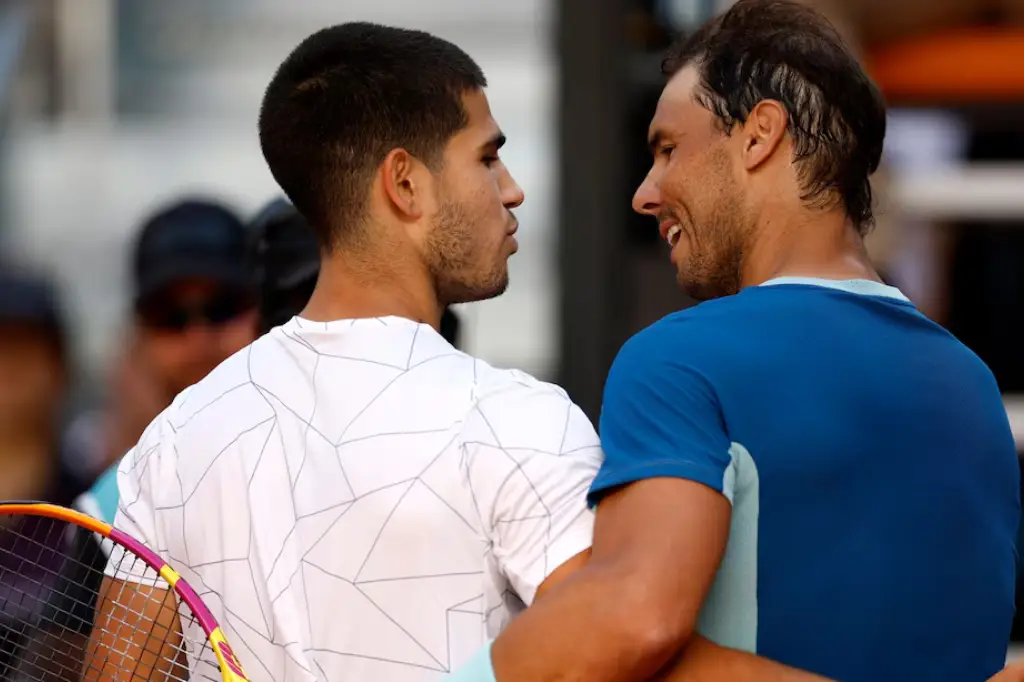
The history of modern sport is shaped as much by choices made in childhood as by trophies lifted in adulthood. Few counterfactuals are as captivating as this one: what if Carlos Alcaraz and Rafael Nadal had chosen football over tennis? In Spain, where football is not merely a game but a cultural bloodstream, this question carries profound weight. Both men grew up with a ball at their feet, both dazzled with natural footballing instincts, and both ultimately walked away from the pitch to redefine tennis history.
Their journeys illuminate a unique foot-tennis era, where Spain’s dominance in football ran parallel to its supremacy in men’s tennis. This article explores that intersection in depth—examining childhood influences, technical traits, cultural context, and the uncanny synchronicity between Spain’s footballing peaks and the reigns of Nadal and Alcaraz.
Carlos Alcaraz: The Futsal Prodigy Who Almost Was
Before the trophies, before the Centre Court roars, Carlos Alcaraz was “Pichichi”—the nickname reserved for goal scorers. Among his schoolmates, he was known not for forehands, but for two-footed finishing, audacious flicks, and instinctive movement. He juggled the ball effortlessly, improvised with the outside of his boot, and scored with a street footballer’s imagination.
Futsal, with its tight spaces and constant decision-making, suited him perfectly. On a court smaller than a football pitch but larger than a basketball floor, Alcaraz thrived because he was never alone. The loneliness of tennis frustrated him. At one point, he openly told his coach that he wanted to quit tennis entirely and commit to futsal.
The turning point was not talent—it was lineage. His father, a former national-level player and a committed tennis coach, intervened. Tennis, he believed, offered a ceiling football could not. That decision redirected Alcaraz’s explosive athleticism, spatial awareness, and coordination into tennis. A decade later, those same futsal traits would become hallmarks of his game: lightning first steps, elastic footwork, and instinctive improvisation.
Rafael Nadal: A Footballer Born Into Sporting Destiny
If Alcaraz flirted with futsal, Rafael Nadal stood at the heart of a footballing dynasty. In the Nadal household, sport was non-negotiable. Rafa’s inspirations were not abstract idols; they were his uncles. Toni Nadal, a frustrated former tennis player, and Miguel Ángel Nadal, a revered defender for FC Barcelona and Mallorca.
Miguel Nadal—nicknamed “The Butcher of Barcelona” for his intimidating presence—was in truth a technically refined, Cruyffian defender with a keen eye for goal. Young Rafa idolised him. As a child, Nadal was a promising striker at his local club, strong, competitive, and fearless in contact.
In one of sport’s great ironies, Rafa Nadal’s first television appearance was not as a tennis prodigy, but as a shy boy cradled in Miguel’s arms during a post-match football interview. Football was not a hobby; it was embedded in his identity. Tennis eventually claimed his devotion, but football never truly let him go.
Football That Never Left: Lifelong Devotion Beyond the Court
Despite choosing tennis, both Nadal and Alcaraz remained deeply tethered to football. They are devoted Real Madrid supporters, emotionally invested in Spain’s national team, and personally connected to footballing royalty.
Nadal’s friendships read like a Ballon d’Or shortlist: Iker Casillas, Sergio Ramos, Cristiano Ronaldo. He once joked—only half-jokingly—about succeeding Florentino Pérez as Real Madrid’s president. During Spain’s 2010 World Cup triumph, Nadal was present at the celebrations, a sporting icon among sporting icons.
On the pitch, Nadal was no ceremonial guest. In a charity exhibition match, he famously scored six goals against Casillas, nutmegging Ramos en route to one and unleashing a thunderous finish past Spain’s greatest goalkeeper. These were not staged moments—they were flashes of a footballer that could have been.
Alcaraz mirrors that devotion. Even in the crucible of Grand Slam tennis, football intrudes joyfully. During Wimbledon 2024, after a brutal five-set win, his first question on court was not about recovery—it was: “How is the score?” Spain was locked in a Euro quarterfinal. He delayed media duties, clutching his phone through an ice bath, apologising only to explain that he could not miss Spain.
The Footballer’s Body in a Tennis Champion
The crossover is visible in their movement. Alcaraz moves like a modern winger, not a traditional baseliner. His explosive acceleration, short corrective steps, and balance under pressure are unmistakably football-bred. A viral video of him performing kick-ups with a tennis ball for nearly nine seconds underscored what coaches already knew: his coordination transcends tennis.
Nadal, too, embodied football’s physical grammar. His lateral strength, anticipation, and relentless pressing mirrored a box-to-box midfielder. His defensive instincts on clay—sliding, recovering, counterpunching—resembled a defender timing a last-ditch tackle.
In both cases, football did not disappear; it evolved into tennis excellence.
Parallel Empires: Spain’s Football Dominance and Tennis Greatness
The most compelling dimension of this story is timing. Spain’s golden age in football (2008–2014) aligns almost perfectly with Rafael Nadal’s prime. When Spain broke their European Championship drought in 2008, Nadal dethroned Roger Federer in an epoch-defining Wimbledon final. When Spain lifted the World Cup in 2010, Nadal captured his first US Open. As tiki-taka conquered the world, Nadal conquered every surface.
When Spain’s footballing empire waned post-2014, Nadal’s dominance softened—but never vanished. Then, after the pandemic, Spain surged again. A new generation arrived. Xavi gave way to Lamine Yamal. Nadal gave way to Alcaraz.
Alcaraz’s explosive arrival coincided with Spain’s footballing revival, echoing the same rhythm of national confidence, creativity, and fearlessness.
Had Destiny Shifted: What Spain Might Have Lost
Had fate tilted differently, Spain might have gained two excellent footballers—but it would have lost two transformational tennis icons. Nadal reshaped clay-court tennis and redefined resilience. Alcaraz is redefining attacking tennis for a new era, blending power with joy.
Neither would likely have become football legends on the scale of their tennis greatness. The margins in elite football are unforgiving; anonymity is common. Tennis, however, allowed their singular qualities to dominate entire eras.
Yet football still won. It shaped their instincts, fueled their passions, and provided a parallel narrative that enriched their tennis careers.
A Shared Legacy of Choice, Culture, and Supremacy
In the end, Carlos Alcaraz and Rafael Nadal did not choose football—but football never left them. Their stories reflect Spain itself: a nation where sport is interconnected, where skills transfer across disciplines, and where greatness often stands at a crossroads in childhood.
Their reigns, like Spain’s footballing triumphs, were not accidents. They were the product of culture, courage, and decisive moments. Tennis gained two immortals. Football gained two lifelong ambassadors.